
When Everything Needs a French Name: Why “Foreign” Food Keeps Winning
- Tec Minn Lee
- Apr 5
- 4 min read
Queues form for the new “patisserie” as the local bakery closes quietly nearby. Our Food and Travel writer, Tec Minn, investigates this recent trend — and what it says about us.

You’ve seen it. The old bakery quietly becomes a “patisserie.” Every new restaurant launch reads like a manifesto: modern fusion, heritage-inspired, European technique with Asian soul… the product, just noodles, be it east or west.
Meanwhile, the truly local stuff — nasi lemak, roti canai, char kuey teow, kuih, kopitiam staples that you can name, is still everywhere, still delicious, still (usually) cheaper but somehow it gets treated as “everyday” and not “cool”.
Local food didn’t suddenly get worse. What changed was the definition of “cool”. Branding, especially, social media, pricing signals, and the way we perform taste in public dictates what’s “cool” now.
A croissant isn’t just pastry; it signals “premium.” Matcha isn’t just tea; it signals “refined taste.” A place calling itself a “patisserie” isn’t just a bakery, it’s telling you: This is curated; this is worth your money and your camera roll. They help people decide quickly: Is this legit? Is it trendy? Is it worth trying? In a city where new cafés spawn after the rain, those cues reduce risk. You feel like you already know what kind of “experience” you’re buying.
Social media didn’t invent the trend but supercharged it.
Food used to be mainly about eating. Now it’s also content. Platforms reward visuals and repeatable formats, and the formula works almost too well: if a dessert looks good in a photo, it gets posted; if it gets posted, people want to try it; if people try it, competitors copy it. Before long, the feed you doom scroll everyday to work is the same ten “must-try” items on rotation.
There is no denying that the aesthetics of food needs refinement, technique and training, but I think we give too little credit to our home-grown champions — the jaguh kampung. Local food can be visually compelling too, but hawker bowls were designed for heat, smell, speed, and comfort, not cinematic reels. That has changed, though mostly out of necessity rather than vanity. It is respected privately, but not always performed publicly.
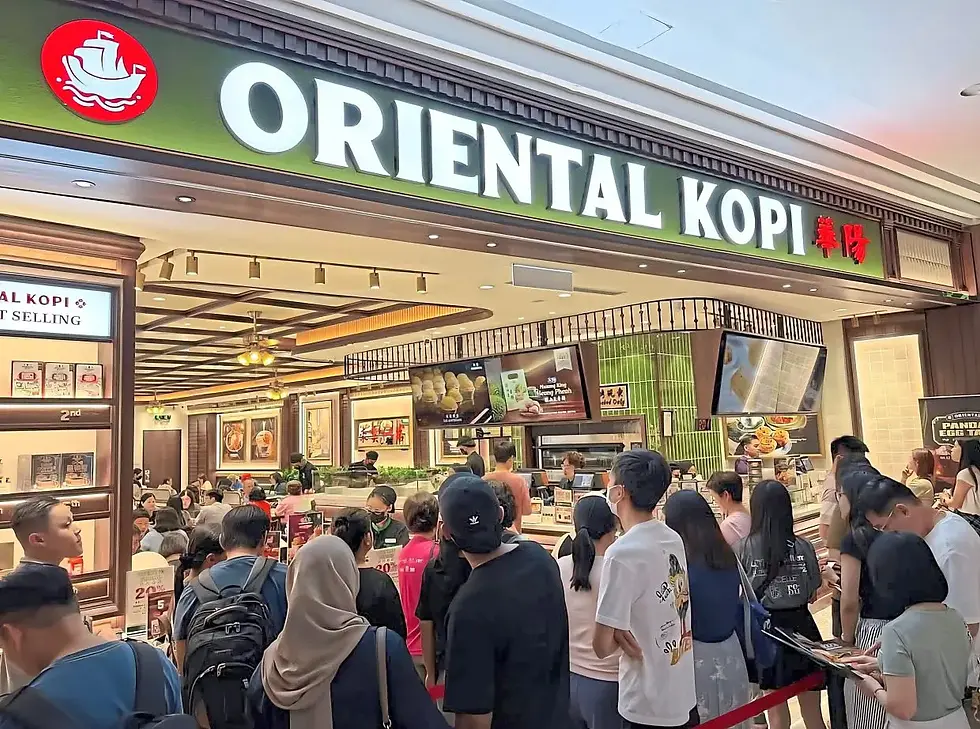
What modern “local dining” looks like now:
The Everyday local (the heart and soul)
Street hawkers, kopitiams, and family-run shops. This is where Malaysians actually eat. It’s efficient and often unbeatable. But with its affordable and familiar nature, it gets labelled as “normal.” People love it privately, but they don’t always post it unless it comes with a narrative in the form of a clickbait phrase (“best in town,” “OG since 1980,” “hidden gem”).
The Modernised Local (the “I’m moving up in life”)
This is where brands like Oriental Kopi and Hock Kee sit: local menus packaged with café aesthetics that bring comfort, consistent plating, clean interiors, predictable service, and branding that feels safe for hangouts, dates, and group dinners. Oriental Kopi explicitly sells itself as a modernised kopitiam experience. Hock Kee positions itself as a heritage/Nanyang kopitiam with a broad outlet network and modern presentation.
The High-End Local (I am the embodiment of local food).
At the top lane is high-end local: Malaysian identity expressed through technique, narrative discipline, and scarcity. Dewakan is a direct example of contemporary Malaysian cooking being treated at the highest level, recognised in the MICHELIN Guide Malaysia as a two-star restaurant and listed with the Green Star designation on its guide page. Auntie Gaik Lean’s Old School Eatery demonstrates a different path: deeply traditional Peranakan food framed and executed at a level recognised with one MICHELIN Star.
They’re not “foreign concepts.” They are local dining made legible to modern lifestyle expectations, and importantly, made legible to social media. Local becomes “cool” the moment it is packaged as an experience rather than treated like routine fuel.

The Price of Looking “Worth It”
Pricing also plays a quiet but decisive role in why local food is often perceived as less “cool.” Cheap and familiar food is categorised as everyday fuel. Expensive, curated food is categorised as an occasion. In public-facing culture, occasion is what gets documented.
A RM8 nasi lemak reads as breakfast while a RM28 cheese tart reads as a treat. The point is not that expensive equals better; but that it more readily signals that the consumer is making a deliberate choice rather than satisfying routine hunger. Price becomes shorthand for exclusivity and intention — an important distinction in a culture where dining is also identity performance.
Taste still matters, but it decides retention, not hype. The first visit is often driven by novelty and social proof: what is trending, what is photographed well, what is being queued for, what the group chat has decided is “worth trying.” After the initial attention cycle, taste and consistency determine whether the place becomes a habit or fades away. The places that last usually have both: a strong narrative and product.
Local food is not uncool; it is under-framed
Local food does not need to imitate foreign food to compete. But it does need framing that matches the modern attention economy: coherent storytelling, consistent quality, and presentation that communicates craft without turning heritage into costume.
The uncomfortable truth is simple: the crowd is not abandoning local taste. The crowd is responding to what is easiest to recognise, easiest to justify paying for, and easiest to broadcast. In that environment, the winners are not always the tastiest. They are often the best framed.


Comments