
From Runway to Racks: Galliano Gets a Barcode at Zara
- Yukthamugi
- Apr 26
- 5 min read
Our resident John Galliano connoisseur, Beauty and Style writer, Yukthamugi, considers whether his collaboration with Zara marks bold reinvention or a compromise informed by accessibility and commercial appeal.

In fashion, the most interesting collisions are rarely polite. They spark, they fracture, they seduce. The newly announced Zara x John Galliano collaboration does all three at once. Slated for September 2026, it arrives less like a partnership and more like a provocation:
What happens when one of fashion’s most theatrical minds steps into the engine room of mass production?
This is John Galliano’s return after a two-year hiatus following his departure from Maison Margiela in 2024, a re-entry not through the hushed reverence of couture but through the fluorescent-lit immediacy of Zara. The premise? “Re-authoring” the brand’s recent archives. Old Zara, reimagined through Galliano’s eye.

It sounds almost poetic. Also deeply strategic.
At first glance, the collaboration is wrapped in the language of sustainability, a buzzword so overworked it now arrives pre-sceptical. Zara positions the project as a creative intervention, where unsold inventory becomes an "archive", and excess becomes opportunity. Galliano himself leans into the narrative, describing a focus on form and proportion that transcends gender, season, and even story. This is not the Galliano of narrative excess, of gilded pharaohs and princesses, of Dior’s decadent dreamscapes. This is Galliano distilled – architectural, restrained, almost clinical.

But can Galliano ever truly be stripped of spectacle? And more importantly, should he?
To understand the friction, one must revisit the Galliano arena. At Christian Dior (1996–2011), he transformed the runway into a theatre. Collections that didn’t just clothe the body but constructed entire worlds. The bias-cut dress, the newspaper print, the Dior saddle bag – each piece is a cultural artefact, steeped in narrative and craft. Later, at Maison Margiela, he pivoted by embracing deconstruction, anonymity, and the poetry of the unfinished. There, repurposed garments were not a necessity but a philosophy.
Zara, however, is not a philosophy. It is a system. And systems demand efficiency.
The collaboration’s timing is almost too perfect. In July 2026, the European Union’s Ecodesign for Sustainable Products Regulation (ESPR) came into force, banning the destruction of unsold stock. For a brand built on speed, volume, and relentless newness, the implications are seismic. Inventory is no longer disposable. It must be dealt with creatively, legally, and visibly.
Enter Galliano, stage left.
The “re-authoring” concept suddenly reads less like an artistic whim and more like regulatory choreography. By reframing unsold garments as an "archive", Zara doesn’t just comply, it aestheticises compliance. Waste is no longer an operational burden; it becomes a design brief.
Because while the collaboration gestures toward sustainability, it carefully sidesteps the more uncomfortable truth: overproduction remains intact. The system that generates excess is not dismantled, merely rebranded. A reworked jacket is still born of a surplus that should not have existed in the first place.
And then there is the question of craft.
Galliano’s name is synonymous with couture precision. Techniques that rely on time, labour, and materials that resist replication. To transpose that language onto Zara’s supply chain is to flirt with illusion. Can bias-cut elegance survive polyester blends?
Sceptics are unconvinced. To them, this is not couture made accessible, but couture aestheticised, with its codes borrowed, diluted, and sold back at scale. A kind of fashion ventriloquism, where the voice is Galliano, but the body is unmistakably Zara.

And yet, to dismiss the collaboration outright would be to ignore its cultural charge.
The idea of Galliano has always been undeniably electric for many. For decades, his work has existed in rarefied spaces. Always seen and admired, yet largely unattainable. Zara offers something unprecedented: global, immediate, and democratic in scale. The girl next door, the student, and the casual observer are all granted entry into a design language once reserved for the elite.
It is fashion’s oldest tension, reframed for 2026: exclusivity versus access.
Zara, for its part, plays this tension masterfully. Under the direction of Marta Ortega Pérez, the brand has been quietly repositioning itself, not just as a retailer, but as a cultural intermediary. This collaboration cements that shift. Zara is no longer simply producing clothes; it is curating narratives, aligning itself with fashion’s most compelling figures, and, in doing so, borrowing a certain intellectual weight. Call it the rise of the “fashion publisher".
It is also, undeniably, a strategic defence: against ultra-fast competitors like Shein and Temu, Zara cannot compete on price or speed alone. Instead, it offers something more intangible: design credibility, cultural relevance, and a sense of participation in fashion as a discourse rather than mere consumption. The Galliano collaboration delivers precisely that.
But even this narrative is not without cracks. The very buzz that elevates Zara’s cultural standing also fuels consumption. Galliano’s name draws attention, drives traffic, and ignites desire. Desire, in the context of fast fashion, rarely remains contained. Consumers may arrive for the “re-authored” pieces, but they leave with bags of something else entirely. The cycle continues, dressed in more sophisticated language. So where does that leave us?
On one hand, the collaboration proposes a genuinely new design model, one that treats mass-produced garments not as disposable but as material worthy of reconsideration. On the other hand, it risks becoming a beautifully constructed façade, one that masks the very system it claims to challenge.
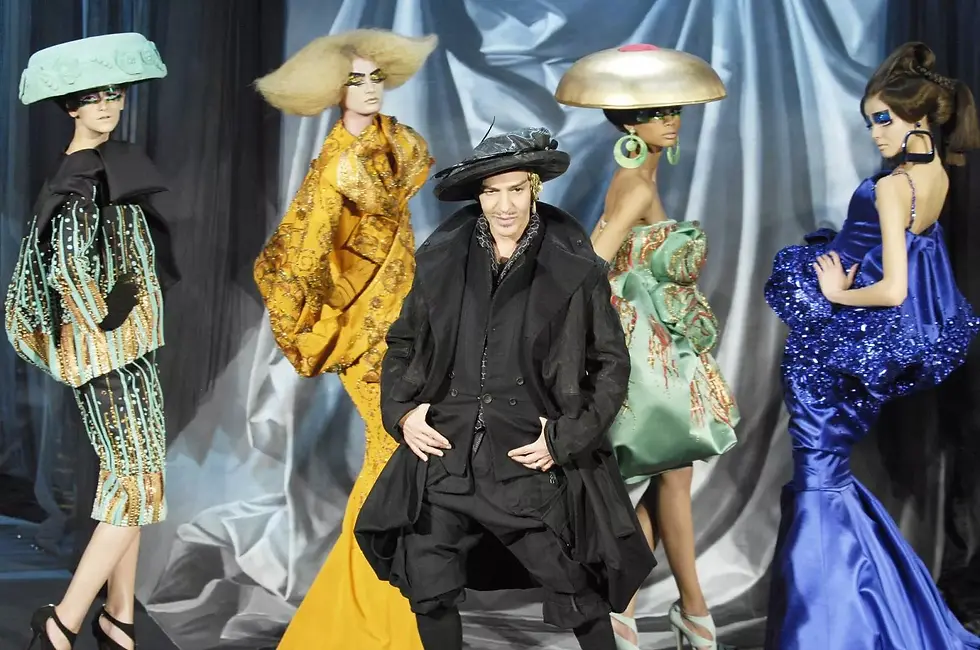
And then, of course, there is Galliano himself.
Is this a reinvention? A compromise? Or something more ambiguous? A designer navigating the realities of a changed industry, where survival demands not just creativity, but adaptability?
Perhaps the answer lies not in theory, but in touch.
When the collection lands in September, it will shed its rhetoric and face its most unforgiving critic: the consumer. Not the abstract consumer of market reports, but the individual running their fingers along a seam, assessing the weight of a fabric, searching, perhaps unconsciously, for the ghost of Galliano within the garment.
Will they find it? Or will they find something else entirely – a hybrid, a contradiction, a piece that exists somewhere between a couture dream and commercial reality?
Either way, Zara x Galliano is not just a collaboration. It is a litmus test. For sustainability. For authorship. For the future of fashion itself.
And like all the most compelling fashion moments, it leaves us with a question that lingers long after the clothes are gone: not just what we are wearing, but why.


Comments