
Can the Stateless be Stated? Political (Non)Representation Meets Its Limits
- Robin

- Mar 13
- 4 min read
On statelessness in Malaysia, the entanglement of the private and the political, and film’s devastating, exhilarating powers.

Marvel, for a moment, at this extraordinary word: being. More than anything, it is a personal, secret sensation: to be is to bask in the flush of life, to feel hunger in the body and the sun’s heat on the skin.
Yet “being” is never only private. To be is also to exist among others, to be seen and heard. This public dimension means that being is inescapably caught up in the net of politics. The subject’s right to assert its presence is conferred by the state, which casts itself as the arbiter of rights. To be stateless, then, is to live in the state’s shadow—ontologically eclipsed, denied validation as a subject. How can we even begin to situate ourselves in relation to the stateless?
Actions that contest the stateless's marginalization are crucial to this effort. IGNITE, in collaboration with Freedom Film Network, hosted a film screening on campus to do just that. The two short films shown, Aku Mau Skola (2018) and Kukutip Cinta Yang Terbuang (2024), center around stateless communities in Sabah. Although different in tone, both films confront viewers with lives that insist on the reality of their being.

Directed by Putri Purnama Sugua, Aku Mau Skola tells of a school that fits inside a small wooden shed and the stateless children who attend it. Stepping sure-footedly over rickety planks and sitting shoulder to shoulder on the floor, the children stake their claim to an education. Their teacher, Rujiah, strives to give them a fighting chance in an unjust world; they are determined to seize it.
The documentary offers an intimate, unblinking view of the children’s lives. Twelve-year-old Ariel takes fierce pride in being in school. He spends long hours at the landfill sifting through trash for recyclables to pay his school fees and hopes to provide his family with a better future. Hairi, the top student, works alongside his father at construction sites and dreams of becoming a teacher. Meanwhile, their fragile school is under the constant threat of government raids, in a world where their very presence is politicized and policed.
Moving hauntingly between the cramped classroom and the barren expanse of the landfill, Sugua’s film reveals not just the hardships of statelessness, but also the children’s perseverance in carving out a place of their own. Here, being is etched in the heartbreaking mundanity of images: it is the crowing of roosters in the background, children playing in muddy puddles and scaling mountains of refuse in battered slippers.

The second film, Kukutip Cinta Yang Terbuang, treats statelessness less as a condition than as lived reality—it was made by young stateless Sabahans, with the support of Putri Purnama Sugua. A product of a filmmaking workshop organized by Borneo Komrad’s Sekolah Alternatif—an initiative in Sabah that provides education to stateless people—the film does not explicitly foreground themes of statelessness. Instead, it is above all a love story: Masyitah is reprimanded by her crush, Sabri, for littering; a friend arranges a date between them; and Sabri eventually accepts Masyitah after she promises to change her ways.
Given this, it is perhaps fitting that trash, which underscores stateless people’s precarity in Aku Mau Skola, evokes in Kukutip a sense of stewardship and care. As the film’s title suggests, picking up trash becomes an act of love—between Sabri and Masyitah, and between the stateless and a country that, legally and politically, rejects them. How, then, can statelessness be viewed as a form of deprivation? At the end of the film, as the young couple walk down a seaside boardwalk and share a Starbucks drink, their love is present as a symbol of hope, an attitude of openness towards new horizons.
Kukutip is not a particularly well-made film—but it is a beautiful and moving one. Between the constraints of representational politics and the state’s negation of stateless being, Kukutip chooses a third path. It reverses the state’s denial of stateless existence by showing that one’s connection to the land of one’s birth is not contingent on any kind of recognition at all. The state’s attempt to politicize being is made redundant; the impossibility of fully grasping another’s being reveals the futility of speaking for others. Instead, Kukutip speaks for itself.
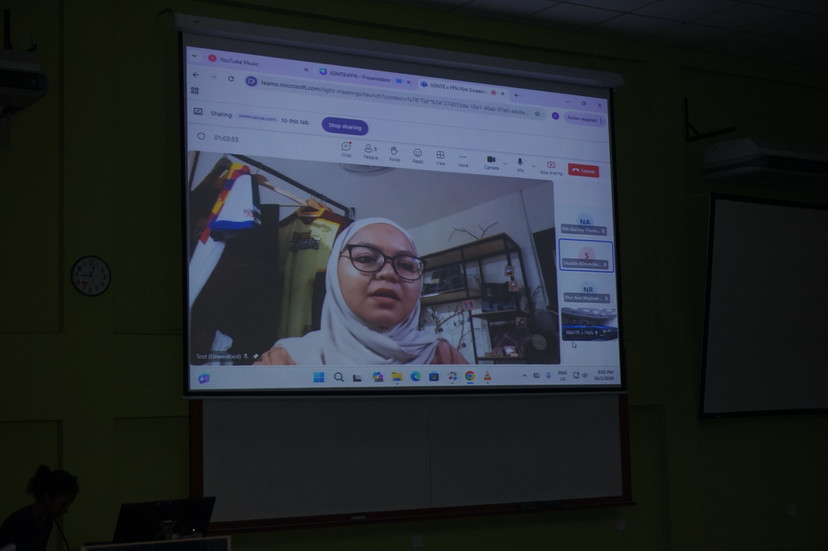
In a post-screening sharing session, the director of Kukutip Cinta Yang Terbuang described the filmmaking experience and her wish to convey the existence of stateless people through film. The day of the shoot was hot, and they had travelled from their village because only a particular location would do for a scene they had in mind. In that gesture lies the limit of political non-representation. The state may withhold recognition, but the act of speaking—of filming—of living—refuses erasure. The stateless speak. If statelessness is not to become as static as the state, the question is no longer how the stateless can be represented, but whether we are prepared to listen.




Writer’s note
Beyond the films, this article was inspired by Borneo Komrad’s Shakila for describing the organization’s history and goals, Dr. Karma’s insights into statelessness’s causes and human toll, and everyone who shared their thoughts in the discussion sessions. Thank you!


Comments