
Screaming “Action!” For Films (In A Literal Sense)
- Azra
- Feb 24
- 7 min read
Updated: Feb 25
Our Film and TV Editor, Azra, speaks with Daisy Crooke from Take One Action on films for social change, the puzzle of film festivals, amplifying the ‘right’ voices and the universal experience through the belief in cinema.

Why do we watch films? There may be a multitude of answers — for entertainment, for clarity, for escapism, for knowledge, for witnessing depiction of lives one may never think of. Do you, perhaps residing in Selangor, think about the livelihoods of people in Kelantan, in Scotland or the indigenous people in Australia? Probably not. I certainly don’t.
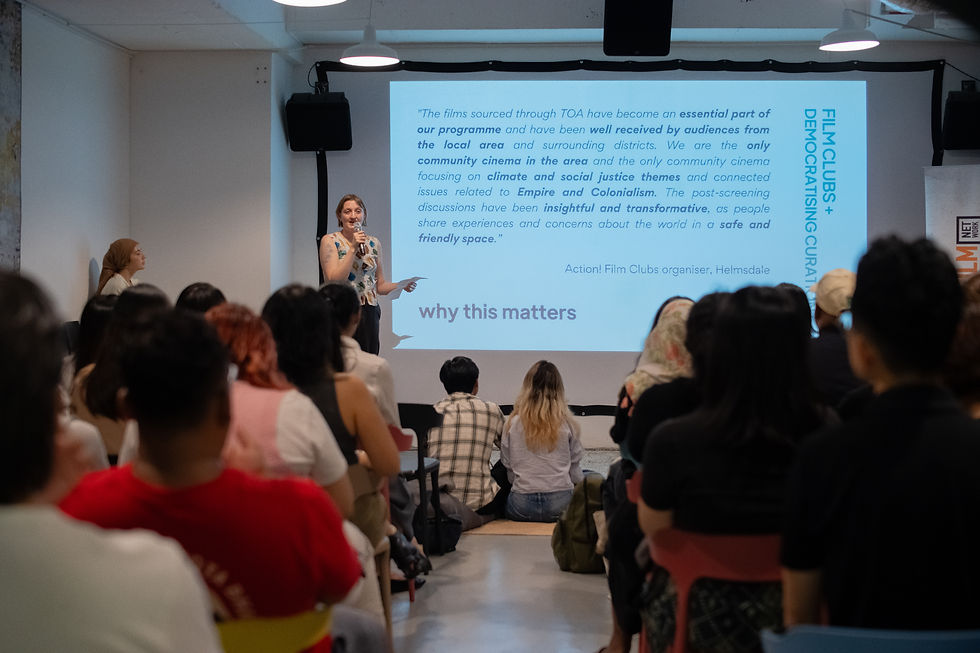
And then it was a Tuesday night, travelling with my peers to a talk called ‘Programming Films for Social Change’ hosted by Freedom Film Network (FFN) of Malaysia and Take One Action, a non-profit organisation based in Scotland, focusing on films and social change. I found myself wondering: What could Scotland, 6000 miles away, possibly be doing with Malaysia? As the evening unfolded, an answer became clear: “Well, why not start thinking of the other people even if they’re miles away?”
A speaker contributing to this revelation was Daisy Crooke from Take One Action, with whom I had the most exciting opportunity to talk to. A woman of the arts, events and communities, the one behind organising film festivals for Take One Action, a lover of films and a believer in their potential. From outlining what Take One Action is to her personal experiences, films for social change and the mechanisms are discussed, unravelling what it really means to take action.

Take One Action, Take Many Actions
For Take One Action, it’s always about the people. Before joining the team, Daisy was a passive cinema-goer who was involved in activist groups, but never really considered how these two aspects could intertwine. Upon volunteering for Take One Action, she was greeted by this beautiful collision of film and social change, and she especially admired how they prioritised the audience. They ensured that the people were comfortable and encouraged them to be active participants. “And it’s what kind of drew me to them, that they’re always asking the question about what happens after the credits roll,” Daisy spoke enthusiastically.
What Take One Action takes seriously, Daisy emphasised, is screening films with context. It’s so people don't leave with muddled emotions and then feel conflicted on where to place them. They also don’t just screen films; they make sure workshops, discussions, or performances accompany these screenings. Context, clarity and active participation: all in hopes to produce a substantial social action.
“Bridging film and social change is really harnessing the power that film can move people and encouraging people to make tangible connections between their own lives and the stories that they're seeing on screen,” Daisy remarked. It’s the sheer cinephiliac belief that film is a material of the soul, intertwining with the humanistic approach in connecting this soul with others through stories. These are stories with ‘change’ as the hopeful destination.
The word ‘action’ is thrown around, but what does it really mean? For Take One Action, it can mean different things. It can look like a protest or reconnecting with your community. Being restrictive about ‘action’ was not part of their belief system.
“It takes all kinds of roles and all kinds of actions to build a social change ecosystem,” Daisy stated. “That is a solid kind of movement.” An action is active, an action varies, an action propels. Jokingly, she said, “What I’ve been saying to people is it shouldn’t be take one action, it should be take many actions!”

Film Festivals Through Their Eyes
Daisy is well-versed in the festivals, having organised and curated them. During Tuesday’s talk, she and the other speakers bonded over their experience of organising film festivals. It was like an unspoken conversation, a struggle they all understood intrinsically. When asked whether she thought of curating film festivals as an art form or largely administrative, she settled on the idea that it’s a bit of both.
Someone had described the curation of film festivals as a ‘puzzle’, and she thought it was a very fitting word. “You have to kind of creatively problem-solve and think about what stories go together well in this kind of curation puzzle,” she illustrated.
The element of creativity is mostly in building relationships with others. “It's a lot of asking communities and different groups what kind of stories matter to them — what do they want to see? Change,” she articulated. “And then we think about how we can make that happen.” What’s as important as creativity is the administrative work: filling out spreadsheets and making sure the event runs, which is what she mostly does. These two are building blocks to attach for successful film festivals – both artistic and ‘dry’ building blocks “for magic to happen.”
Take One Action’s film festivals had already moved away from traditional festival models, which sets them apart from their peers. Their biannual festivals are already unconventional, with no premieres, galas or awards, which really hammers home their prioritisation of collectivity over competition. They also greatly value rest and their staff's mental health. “We kind of don’t really subscribe to that festival elitism,” she reasoned. This was one of the aspects she was fond of: detaching themselves from the ever-so-familiar capitalist modes of festivals.

‘Voices’ To Be Heard
I dropped a pretty huge question on her, a question that echoes through most activists: how do you feel about the voices you’re helping to amplify? To which she firmly answered, “That they need to be heard”.
Daisy noted how Take One Action focuses on who is telling the stories. She addressed the documentary scene as we know it now, which is filled with white filmmakers from the North making films about global-majority issues. They tend to be extremely Western-centric, and shaped by their Western lenses (see: the documentary categories in the Academy Awards). Take One Action tries to disrupt this.
“We really prioritise films that are made by people who have lived experience of the stories that we’re seeing on screen,” she stressed. It’s all about amplifying the ‘right’ voices that need to be heard. Stories that are underseen, with experiences that are undercovered.
She shared an example of a screening that moved her deeply– a film titled ‘In My Blood It Runs’, centring around an Aboriginal, an indigenous Australian boy and his experience in the education system, which is severely colonial. The film was screened across Scotland and had a campaign around decoloniality in schools. Having the audience ponder how colonialism affects education and actually do something about it is a real, tangible impact. This is one of the voices Take One Action is amplifying.
It was beautiful to know how audiences in Scotland were exposed to such a personal story and could stomach it in light of their own context. The human experience, I would argue, is not entirely far off. Whether you’re in Australia or somewhere miles further, you could share more relatability than you would think.
The Universal Experience
When the interview took place, Daisy had been in Malaysia for a few days. She found the work of FFN inspiring and thought Pesta Filem Kota Bharu was commendable. One thing she and I both learned was the existence of that particular festival in Kota Bharu, Kelantan, and their efforts to revive cinema culture in a cinemaless land (hence why these events and workshops are so important!).
“It was a really lovely reminder that this work happens everywhere, and that we don’t need to wait for permission or the perfect conditions to do it,” Daisy commented, thinking about Pesta Filem Kota Bharu and FFN. “The challenges and barriers they’re facing are so much more than the ones that we have in the UK, and they’re still doing it.”
And despite all those differences, to Daisy, there was one thing that her work in Scotland and the work in Malaysia shared– the idea of community building through film. There’s the word again: community. Regurgitated a million times, but even so, it never does end up sounding vague. Community is what it is– a group of people. Whether they are in one place or dispersed, they are still sharing similar traits. In this case, one trait that Daisy, Take One Action, FFN and Pesta Filem Kota Bharu share is the belief in film.
“The context is very different, but ultimately the goal of collective meaning, making and building collective power for social change is the same. All of us at the end of the day believe in the power of film.”
And it’s true. Somewhere here, maybe a filmmaker is hoping to capture their life and share it with others. Somewhere in Edinburgh, maybe another filmmaker is thinking the same. And someone could be reaching out to Take One Action as I write this. It’s the universal belief in film that makes a community.
Think About Change
Daisy’s dream is for film and social change to be a stable sector across Scotland. For communities to keep growing and hosting film screenings, doing their own thing. These initiatives may not necessarily be tied to Take One Action, but they would still be rooted in the foundation the organisation has built. Ultimately, she hopes Take One Action will leave a long-lasting impact on society, transforming a society of inaction into one full of action.
And we, too, can dare to dream of action. To anyone who believes films could say so much more, interested in bridging films and social change, hosting film screenings, Daisy’s message is simple:
“Don’t think about the film straight away. Think about the other things. Think about what you want to change, and then see how film can be used as a tool for that.”
Behind the cameras, behind the stage, among the crowds– scream “Action!” no matter where you are, in the name of change.


Comments