
The Legacy Satoshi Kon Deserves
- Bali Meranti Adrian
- Feb 13
- 4 min read
If you don’t know Satoshi Kon by name, you’ve felt his influence. Our Film and TV Writer, Bali, breaks down the legacy of one of animation’s most visionary minds.
In a world dominated by Western media, we often forget that the ideas behind them may have originated elsewhere. You might recognise these two distinct stories: a performer pushed to the edge of her sanity, and a mind-bending journey in which characters navigate layers of dreams. The first being Darren Aronofsky’s cult classic Black Swan (2010), and the second being Christopher Nolan’s critically acclaimed Inception (2010). But what if I told you that these works can actually be traced back to two visionary Japanese films: Perfect Blue (1997) and Paprika (2006)?

Meet Satoshi Kon.
A Japanese manga artist turned film director, Kon gravitated towards animation because he felt his rapid, intricate editing style would be too fast-paced for live-action. Kon became known for his signature interplay between dreams and reality and his precise use of match cuts and visual transitions. Across four films, one TV series, and a short film, he pushed the medium into a psychological and cinematic territory with a boldly adult tone.
Kon’s approach to filmmaking was meticulous. “In the case of animation, editing is done first,” he once wrote, highlighting how he planned each sequence in storyboards before any actual animation began. For Millennium Actress (2001), he hand-drew over 400 pages of storyboards, essentially pre-editing the entire film on paper.

Beyond his films, Kon’s humorous and self-deprecating manner shone through his avid blogging. Through his writings, Kon heavily reflected on his ‘guilt’ piles of animation cuts, the constant struggle to keep projects on schedule, and the balancing act of creativity and resources. It is in these glimpses of his life that we witness his remarkable ability to transform the ordinary into the extraordinary.

Perfect Blue, Kon’s most acclaimed work and my personal favourite, centres on Mima Kirigoe, a J-pop idol turned actress. For a debut film, Kon’s usage of surrealist storytelling is revolutionary. Through a combination of masterful editing and innovative use of animation with alienation techniques such as ‘Verfremdungseffekt,’ Kon manipulated time, space, and perspective, immersing viewers in his characters’ psychological realities. By weaving surrealism into the narrative, he perfectly captured Mima’s unravelling mental state as she confronted the pressures of rising fame and the toxic landscape of celebrity worship, objectification, and voyeuristic obsession.
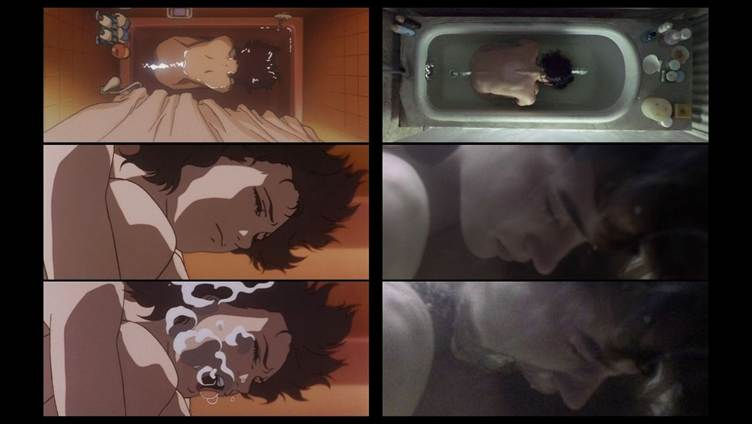
American filmmaker Darren Aronofsky was so enamoured by Perfect Blue that he recreated a scene frame-for-frame in his film Requiem for a Dream (2000), under the guise of an homage. This stirred discussion among audiences about the lack of appropriate credit for Kon’s influence. Aronofsky also attempted to acquire the rights to the live-action remake of Perfect Blue, but the deal never went through. Nevertheless, rumours claiming that he had obtained them spread, which is why when his film Black Swan (2010) was released, many fans believed it to be a spiritual remake of Perfect Blue. Especially due to the strong similarities between their plots and themes. Although Kon is generally believed to be one of Aronofsky’s main filmmaking influences, Aronofsky has denied any direct influence for Black Swan.

In Kon’s final film, Paprika, we follow the story of a young female scientist who pioneered the invention of a device, allowing her to enter other people’s dreams to guide them through their subconscious. Regarded as a perfect marriage of form and subject, Paprika keeps audiences suspended between dream and reality.
On the surface, some elements appear to mirror Christopher Nolan’s Inception, sparking debate over whether Nolan drew inspiration from Kon’s film. While the two share thematic similarities, equating Inception’s action-focused heist narrative to Paprika’s surreal exploration of collapsing realities oversimplifies both films. Furthermore, Nolan has never explicitly cited Paprika as an influence on Inception.
The subtlety of influence is that works can echo one another without being derivative.

However, just because they’ve denied directly copying Kon, it doesn’t mean that Western auteurs such as Nolan and Aronofsky should escape scot-free. The comparisons persist for a reason: Kon never received the same recognition, funding, or institutional support that they did. So even if they weren’t directly inspired, it’s important to acknowledge that Kon’s directorial style has definitely seeped their way into the modern framework of cinema. This continual discourse attests that even when Kon goes uncredited, his style is recognisable enough for audiences worldwide to readily label similar scenes as something unmistakably “Kon-esque.”
It’s just a shame that this acknowledgment seems to have arrived only after his death.

Kon’s body of work is heartbreakingly small; he died in 2010 at just 46, and reading his final letter brought me to tears. His passing left one unfinished project: Yume-Miru Kikai (The Dream Machine). Unlike his previous films, it was intended as a whimsical science-fantasy for younger audiences. Despite Kon’s extensive storyboards and notes, the project ultimately stalled in 2018 due to struggles with financing and something far more intangible: they couldn’t find anyone capable of directing it the way Kon could.
Kon was a director who proved that animation wasn’t merely a “genre” or a children’s format — it was a medium capable of daring ideas and disturbing relevance. Perfect Blue anticipates today’s parasocial culture, where public personas fracture under constant surveillance and online obsession. Likewise, Paprika feels eerily prophetic in an era defined by overstimulation, algorithmic feeds, and collapsing boundaries between inner and outer realities.
Ultimately, Kon’s legacy isn’t about who had ‘copied’ him; It’s about how he altered cinema, regardless of the stigma surrounding foreign and animated films. While it may be too late for Kon to fully experience global commercial success, the least we can do now is celebrate his works and regard them with the proper appreciation and respect they so clearly deserve.
As Kon wrote in his final letter:
To everyone who stuck with me through this long document, thank you. With my heart full of gratitude for everything good in the world, I’ll put down my pen.
Now excuse me, I have to go.


Comments