
FIFA Arena: The Mini-Pitch That Could Transform Malaysian Football
- Dinesh
- Jan 28
- 6 min read
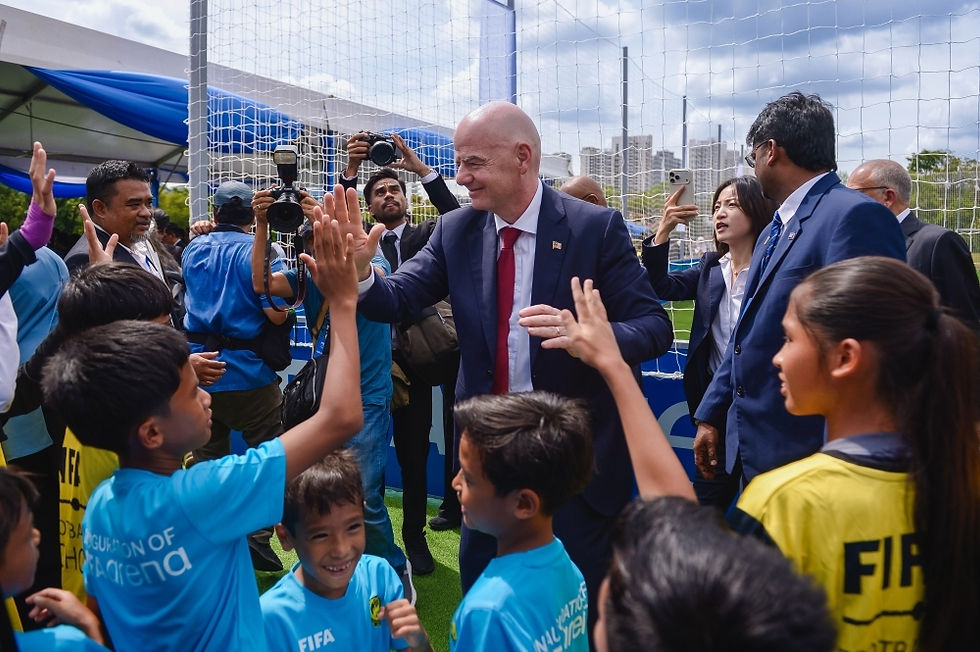
The scandal was devastating. Seven foreign-born players banned, 350,000 Swiss francs in fines, and a nation's football reputation in tatters. Yet just weeks after FIFA called it "cheating, pure and simple," President Gianni Infantino stood on Malaysian soil to inaugurate the country's first FIFA Arena mini-pitch at Sekolah Kebangsaan Sri Kelana on October 25, 2025. The message was clear: FIFA hadn't abandoned Malaysia—it was betting on its future.
But can two 20x40-meter artificial pitches really change the landscape of Malaysian football? The answer lies not in the infrastructure itself, but in the ecosystem it could help rebuild—and the regional opportunities now emerging through ASEAN cooperation.

How Does FIFA Arena Actually Work?
FIFA Arena isn't just about adding playing surfaces. The initiative supports the United Nations Sustainable Development Goals by promoting inclusivity and providing safe, accessible spaces for children to play, learn, and grow. The two initial pitches at SK Sri Kelana and SMK Putrajaya Presint 11(2) will directly benefit 1,300 students, with another 4,500 reached through integrated Football for Schools (F4S) programmes.
As the Kyrgyz Republic's football federation president noted during their own FIFA Arena launch, the initiative provides "the young generation direct access to quality sports infrastructure"—something Malaysian children have lacked for decades. The advanced, infill-free artificial turf means year-round accessibility regardless of weather, eliminating the excuse of unusable facilities during monsoon seasons.
During the launch, Infantino emphasized that "hundreds of children can benefit from this programme," noting that FIFA has built arenas in 20 countries with 200 more planned. For Malaysia, the target is 30-50 pitches by 2030, integrated with F4S in 237 schools nationwide.
The Real Game-Changer: Talent Pathways and Early Development
Infantino articulated the broader vision: "The opening of the FIFA Arena will help change children's lives and create safe and accessible spaces where they can play, learn, and grow. The vision is to inspire millions of boys and girls around the world, promote inclusion, and use football as a valuable tool for social change."
But inspiration needs structure. Malaysia's F:30 Roadmap promises world-class status by 2030, yet the country has only approximately 1,200 licensed coaches compared to Vietnam's 5,000. FIFA Arena addresses this by creating consistent touchpoints where talent can be identified early—not in exclusive academies that only elite families can access, but in public schools where potential stars from underserved communities can emerge.
A teacher at SK Sri Kelana captured this perfectly, telling Bernama: "The kids lit up when Infantino kicked a ball with them; this pitch isn't just turf, it's a future."
Regional Renaissance: The ASEAN Summit Connection
The timing of Infantino's visit proved strategic. His October arrival coincided with the 47th ASEAN Summit (October 26-28, 2025) in Kuala Lumpur, themed "Inclusion and Sustainability." Prime Minister Anwar Ibrahim met with Infantino to discuss how FIFA Arena could nurture local talent and elevate ASEAN football as a collective force.
The highlight: a renewed five-year Memorandum of Understanding between FIFA and ASEAN, signed by Infantino and Secretary-General Dr. Kao Kim Hourn, with Anwar witnessing as 2025 ASEAN Chair. Building on agreements from 2019 and 2023, this MoU targets sports integrity, social development, inclusion, and climate-resilient infrastructure—directly countering scandals like Malaysia's by emphasizing ethical growth.
The crown jewel of this partnership? The inaugural FIFA ASEAN Cup—a national team tournament inspired by the Arab Cup, uniting all 11 ASEAN members, including new entrant East Timor. "Football unites the world," Infantino declared, predicting it would "boost national team football in the ASEAN region and support development across Southeast Asia."
For Malaysia, reeling from bans that voided suspect results, this tournament offers profound benefits:
Redemption Platform:
A chance to showcase reformed squads built on homegrown talent developed through FIFA Arena and the National Training Centre, restoring credibility on a regional stage.
Competitive Exposure:
Regular high-level matches against Southeast Asian rivals will accelerate development far better than friendlies, giving young players emerging from FIFA Arena programmes a clear path to international competition.
Regional Hub Positioning:
As Prime Minister Anwar noted, hosting ASEAN Cup qualifiers and potentially the finals at the new Putrajaya NTC aligns with positioning Malaysia as a "regional hub for football excellence",transforming FIFA's USD 5.2 million investment and the government's USD 9.5 million contribution into tangible diplomatic and sporting returns.
The MoU represents more than football diplomacy. It's FIFA's public commitment that despite the naturalization scandal, Malaysia remains worthy of investment and leadership in Southeast Asian football development.

What Must Change: Three Critical Reforms
Infrastructure and regional tournaments won't matter without systemic reform. Here are three non-negotiable changes Malaysia must make:
Governance Overhaul: Clean House at FAM
The scandal exposed dangerous organizational rot. Sports analyst Datuk Pekan Ramli's assessment is blunt: Former Youth and Sports Minister Hannah Yeoh's plan for world-class status by 2040 "will remain unfeasible as long as FAM is led by its current personnel."
What's needed:
Independent audits of all naturalizations since 2015, mandatory term limits for FAM EXCO members, democratic elections with fan and club representation, and complete decoupling of professional league operations from state FAs. Yeoh's suspension of additional grants until "every ringgit of public funds is fully accountable" must become permanent policy—no funding without transparent quarterly reports showing exactly how FIFA Forward money and government allocations are spent.
The players admitted they signed citizenship documents in Bahasa Malaysia without understanding them, trusting FAM and agents based on "family hearsay." This isn't just incompetence; it's institutional negligence that FIFA has now flagged to Malaysian criminal authorities and officials in Argentina, Spain, Brazil, and the Netherlands.
Clean leadership isn't optional; it's survival.
Professionalize Coaching Pathways From Grassroots to Elite
A FIFA study of the global talent development ecosystem shows that "professionalization of talent development structures is the key to success for domestic leagues and international teams, and data and analysis is the key to that professionalization."
What's needed:
Malaysia's 1,200 licensed coaches are outnumbered 4-to-1 by Vietnam's 5,000. Every FIFA Arena facility must have at least two grassroots coaches completing UEFA B or AFC licenses within 24 months, with FAM providing subsidized education targeting 2,000 licensed coaches by 2028. Research shows successful academies "adopt a more calculated, less random approach to talent development" using "past markers to determine what a talented athlete looks like,” focusing not just on technical skills but players' "physical and mental health, maturity, and more."
England's Elite Player Performance Plan (EPPP) provides a model: comprehensive development programming where "contracted players have additional access to coaching, as well as opportunities for in-house full-time education programming." Malaysian academies must integrate academic support, ensuring players who don't reach professional rosters have life skills and qualifications.
Build Transparent Talent Pipelines With Data-Driven Scouting
Currently, Malaysia's pathway from grassroots to national team exists in disconnected silos. Research shows "football academies significantly contribute to both on-field success and off-field commercial outcomes," with significant correlations between academy-developed players and league performance (r = .62, p < .01).
What's needed:
Transparent criteria connecting FIFA Arena grassroots to state Football Associations to national academies to Super League clubs to national team selection.
FAM must deploy scouting networks at every FIFA Arena location, using standardized quarterly assessments to identify emerging talent aged 8-12 before they slip through cracks. In the United States, FIFA's Innovate to Grow initiative shows results by "increasing youth participation, improving retention rates, removing social and economic barriers to access in underserved organizations, and encouraging diverse forms of play."
The ASEAN Cup makes this urgent. Malaysia needs a pipeline producing 15-20 competitive national team players annually by 2030. Not shortcuts through questionable naturalizations. As Mokhtar-era star Soh Chin Aun reflected: "We built pride without shortcuts; now, with these arenas, we can again."
The Verdict: A Second Chance Malaysia Can't Afford to Waste
Former Youth and Sports Minister Hannah Yeoh captured the stakes perfectly: "Through partnerships like this, we are paving the way for more structured and sustainable youth football programmes, not only to identify future talents but to shape a generation who value teamwork, discipline, respect, and leadership."
FIFA has given Malaysia extraordinary gifts: Arena mini-pitches, a USD 5.2 million National Training Centre, the ASEAN Cup platform, and continued institutional support despite scandal. The infrastructure is being laid. The regional stage is set. But whether today's 8-year-olds kicking balls at SK Sri Kelana become the Harimau Malaya heroes lifting the ASEAN Cup in 2028 depends entirely on the three reforms outlined above.
Governance. Coaching. Pathways. Get those right, and FIFA Arena becomes the foundation of a football renaissance. Get them wrong, and these beautiful mini-pitches will be monuments to wasted potential. Reminders of what might have been if Malaysia had matched FIFA's faith with its own commitment to honest, systemic reform.
The choice is Malaysia's. The clock is ticking.



Comments