
Art Didn’t Fall Out of a Coconut Tree – The Illusion of Apolitical Art.
- Hitesh M.
- Mar 29
- 6 min read
“I want to keep politics out of art” is a sentence that’s oxymoronic by nature; because when has art ever shied away from politics? The discourse of keeping art separate from politics or to apoliticise art may seem logical at first: art can just be art, without having to make everything a commentary on capitalism, patriarchy, or colonialism. “Art should be an escape from reality,” some say. “Stop politicising art and keep it out of politics, don’t bring that here,” say others. If only it were that simple. And yes, it is that deep.

The Myth of Apolitical Art – Celebrities, Cowardice, Complicity.
Over the past month, social media has been inundated with clips of celebrities from the Berlinale Film Festival claiming to be indifferent on the most pressing issues of our time when asked by the press. The crisis began when the Competition Jury president, Wim Wenders, was asked about the role of politics in cinema. In a futile attempt to weather the storm, Wenders replied saying that filmmakers “have to stay out of politics” and labelled cinema “the counterweight of politics…the opposite of politics.” These remarks led to Booker-winning author Arundhati Roy, a staunch critic of the Indian government and its role in Kashmir, to withdraw from the festival and calling Wenders’ remarks “unconscionable”. This led to a flurry of interrogation by the media on attendees about the role of politics in film.

Malaysia’s pride, Oscar winning actress Michelle Yeoh, got caught in the crossfire of questions from the press at the Berlinale Festival. When asked about the U.S.’s political landscape, Yeoh responded: “I don’t think I am in the position to really talk about the political situation in the U.S., and also I cannot […] say I understand it, so it is best not to talk about something I don’t know about. But I think I want to concentrate on what is important for us, which is cinema,” and proceeded to respond to a follow-up question about the state of diversity in Hollywood.
Whilst expressing that she cannot understand the political situation in the States, there isn’t really much to understand about immigration and the violence perpetrated by ICE against immigrant communities or the mass cover up of the Epstein files by the Trump administration to protect the few and wealthy, or simply the descent into fascism. An actress with a $40 million net worth hasn’t much to lose, but an immigrant working class family who’s caught by ICE has everything to lose.

Michelle Yeoh seems to forget her speech at the Oscars just a few years ago: “For all the little boys and girls who look like me, watching tonight, this is the beacon of hope and possibilities. […] And ladies, don’t let anybody tell you you are ever past your prime”. A speech in which elements of both race and gender are meshed is inherently political, pointing out the shortcomings of Hollywood in giving people of colour roles and its mistreatment of women.
The Berlinale Festival also saw actor Neil Patrick Harris respond to a question asking if films should be political and if they yield the power to fight fascism, to which he replied: “I think we live in a strangely algorithmic and divided world right now, and so as artists, I’m always interested in doing things that are apolitical”. A lukewarm response that could only fulfill the ambitions of a White man in Hollywood who is unaffected in an age of rampant sexism and white supremacy. So, Neil Patrick Harris’ future aspirations in Hollywood are to simply create ten more sequels of The Smurfs. How Smurf-tastic.
Inspecting Art’s Politics
But could art really be apolitical? It depends. Let’s consider art as books, film, and music. Literature tends to be political by virtue of being a replica of society: The Handmaid’s Tale, The Great Gatsby, Animal Farm, The God of Small Things, The Hunger Games. Film doesn’t have to be but always involves elements of human interaction, which is influenced by political elements such as race, gender, skin colour, sexuality, or nationality. Even the casting, funding, and directing processes of film are political. Combining both film and literature, you may be familiar with discourse surrounding Emerald Fennell’s adaptation of Wuthering Heights by Emily Brönte, of which people have pointed out the discarding of Heathcliff’s racial identity in the novel and instead white-washed it. As for music, if you’ve watched Bad Bunny’s Super Bowl halftime show you’d have familiarized yourself with the political implications of performing a non-English show during a Trump presidency. Art is a resemblance of the contemporary cultural zeitgeist, thus is almost always a reflection of political realities. So Kamala Harris was right, we did not just fall out of a coconut tree and we do exist in the context of all that came before us.
We could even take art such as frescoes, murals, or graffiti as being political. Picasso’s Guernica (1937) is regarded as being a powerful anti-war artwork during the Nazi’s bombing of Spain, depicting the suffering of civilians and animals who paid the price of political jingoism. Fahmi Reza is an example of art being political, being renowned for his clown portrayal of former Prime Minister Najib Razak during the 1MDB scandal.
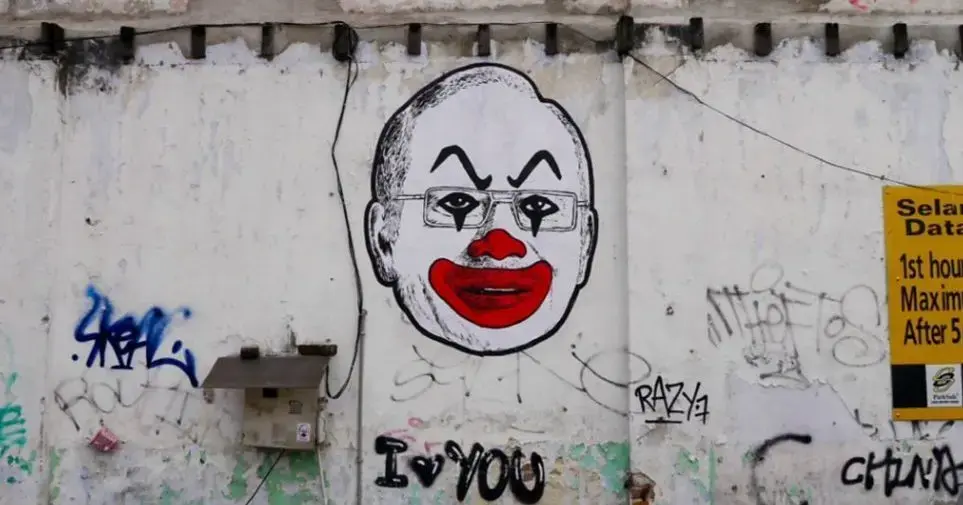
Art is a medium, hence the term ‘artistic expression’ is almost always used when discussing what the artist is conveying and how they do so. It is the ‘what’ that encapsulates the message of the artists, and is usually a social commentary. To comment on society is to comment on the structures that forge it: people, language, money, race, gender, cultures. All of which is dealt with and constituted by or through politics.
Make no mistake that art, whatever form it may take, is inherently political and has been/is used by governments as a modus operandi to mould a population’s beliefs. If art weren’t political, book burnings would not have taken place in Nazi Germany. If art weren’t political, Malaysia would not have a Film Censorship Board (LPF) to redact media deemed ‘inappropriate’. If art weren’t political, Malaysia’s Ministry of Home Affairs would not have taken the trouble to ban books deemed harmful to public morality for simply including LGBTQ+ elements. We seem to only care about art when it entertains, and turn a blind eye when it's suppressed.
You Are What You Watch, Read, and Hear.
Refreshingly at the Oscars over the weekend, filmmakers and actors made their voices heard and amplified political messages. Before presenting the award for Best International Film, Javier Bardem declared “No to war, and free Palestine”, garnering applause from the audience, and nothing from a stone-faced Priyanka Chopra. But the most important one to me was David Borenstein, director of the winner for Best Documentary: Mr Nobody Against Putin. Borenstein remarked: “You lose your country through small acts of complicity”. A direct comment on the Trump administration’s immigration crackdown, his appetite for speaking out is one that should be mirrored in Hollywood, as those with power, prestige, and privilege have the potential to bring real pressure to bear on policies that affect the most vulnerable.
Art is often the beacon for progressivity and progressive politics, and so to depoliticise it is to detach it from reality and pretend they exist in silos. To quote Oscar Wilde, life imitates art. Ever get the feeling that you’re a whole new person after watching a new movie and you need to make this your whole personality? Right, that was me after Heated Rivalry. We imbibe the art we consume behaviourally, they take up a space of our memory and subconsciously influence the way we see the world. And so more importantly, art imitates life. The movies you watch, the books you read, the paintings you view, are all told by a director, an author, or an artist who hold life experiences contingent on their upbringing and social milieu which were by logic constructed by the political systems and zeitgeist around them. So to negate their context is to abandon the very factor making every piece of art unique.
Writer’s note:
This idea first came to me when my social media was bombarded with news surrounding Michelle Yeoh’s comments made at Berlinale, and increasingly the responses of other celebrities being exposed as well. I was pissed, to say the least. Initially I thought it obvious, so didn’t feel the need to write an article about art being political but eventually decided that it’s one worth discussing because it is in fact nuanced. On the one hand (most of the time), I think that art and politics are inseparable. It’s because of this very reason that we decide to boycott art that promotes values we deem regressive. It’s because of this tethered relationship between art and politics that we choose to divest art that isn’t socially acceptable. The next reasonable question to ask is if art should be separated from the artist, of which I think it shouldn’t be. We (should) put our money where our values lie, and that includes art. I sometimes feel that those who advocate for the separation of art and politics do so to abdicate guilt, and I get it. But the tendency to abdicate guilt indicates social privilege, which is political. (Call me woke idc).


Comments